


Begonias can bloom for such a long time that you wonder how they manage it… In fact, they can run a flowering marathon all through the season, from spring to fall! New buds open every day, and so many of them that your garden will never look dull or colorless, in fact – if you treat them well though, otherwise, they can get tired, fatigued, especially after the first burst, and when days get a bit too hot for them.
But there are many tricks to keep your begonias blooming through summer and into fall, the first of course, is to give them love and tender loving care, but if you want to know the others, you’ll have to read on and find out…
1: Find the Right Spot to Keep Your Begonias Blooming
Location is of the essence to keep your begonias blooming lushly through the season, especially in summer… In fact, they will blossom well in full sun during fresh spring days, but come late June, they may stop.

Begonias like partial shade outdoors, but never deep. They need about 4 hours of bright light a day to blossom profusely, and when it gets too hot, they will feel fatigued in full Sun; what’s more their leaves may burn.
Ideally, your begonias will thrive with morning sunlight and afternoon shade.
Also, shelter them from strong winds, yet another factor that can get them to stop flowering.
If you keep them indoors, make sure your begonias have bright but indirect, filtered light. Do not put them close to a window, or they will dry up and “burn”, lose color, and fail to flower.
So, ideally, you should put them at least 3 feet away (1.0 meters) from an east facing window, a south facing one will be fine, but it must be curtained.
2: Begonias Need the Right Soil to Flower
Even if the place is right, and the soil is wrong, your begonias will disappoint you. To start with, the soil needs to be fertile and organically rich, but well drained.
Outdoors, the ideal soil for a massive floral display is sandy loam, loam with added drainage comes second, and begonias can manage light but well drained clay, but not heavy, and chalk is really unsuitable for them.

If your soil is not suitable, you can amend it or better still, grow them in containers or raised beds.
What’s more, begonias like acidic soil, with pH between 5.5 and 6.5 for best results, but they will do well in neutral environments as well (that’s why they don’t tolerate chalk – it’s alkaline).
Correct the pH with sulfur or other ways if necessary (remember, the more organically rich it is, the more the pH hits the right range for begonias, and this is by far the best way).
However, indoors or in containers, the really ideal potting mix is:
- 1 part coco coir based planter mix
- 1 part leaf mold (preferably oak)
- 1 part small (1/8 in to 1/4 in) size orchid bark
- 1 part coarse sand or larger perlite
A mix of 1/3 compost based potting soil, 1/3 coco coir, sphagnum moss or substitute, and 1/3 perlite or coarse sand will do, if you can’t find leaf mold and coco coir planter mix.
3: Feed Your Begonias Well and They Will Blossom Non-Stop!
Of course, if begonias lack nutrients, they stop blossoming, but also if you give them the wrong ratio. Again, we need to distinguish those you grow outdoors and the ones you keep indoors.
Outdoors, I suggest you give them a good 2 inches of compost when you plant them and I have a tip for you add half a spoonful of Epson salt for each plant… It will work wonders for their blooms later on!
Then, wait till you see the first flower buds, and feed them every two weeks (maximum three) with a fast release liquid fertilizer with NPK 5-10-5 or 5-7-5. Avoid the all round 10-10-10, it will promote foliage over flowers, but they still need nitrogen for their lush leaves.
On the other hand, indoors, you don’t need to fertilize them at first, but use the same routine (fast release liquid fertilizer with NPK 5-7-5 or 5-10-5 every other week) as outdoors as soon as you see the first buds.
In case you see your begonias become weak before they produce flower buds, then give them a quick boost with a fast release liquid fertilizer with NPK 10-10-10 or 20-20-20.
4: Water Your Begonias Regularly and They Will Flower Continuously
Of course, watering is very important too – a thirsty begonia has no energy for flowers! This will also have to change during the season, but the general rule is to irrigate them when the top 1 inch of soil (2.5 cm) is dry. Just put your finger in!

This may be every 2 to 4 days for potted plants, and every week for garden begonias, but be very flexible. In summer, you will have to water them more frequently, especially in containers – even every day when it is really hot.
Water your begonias in the evenings, unless it is extremely hot, in which case you can switch to the morning, especially with potted ones.
And if they are in containers, make sure you water them from below… Fill the saucer and let the soil and your begonias’ roots soak up as much as they need, then empty it after about 30 minutes (maximum one hour).
Next, don’t give your begonias cold water, it needs to be room temperature – and strong change can shock them and stop these plants from blooming.
Finally, begonias prefer rainwater, tap water is usually far too alkaline for them, and, as you know they like acidic environments.
5: Keep Your Begonias Free from Pests and Fungi

Have you seen how tender the leaves of your begonias are? Can you imagine what a temptation they are for pests, that can hide from you under their lush foliage? In fact, these plants are susceptible to mealy bugs, spider mites, thrips, scales, snails and slugs, as well as fungi and molds.
Unfortunately, begonias are susceptible to pesticides, especially chemical ones, so, if you use them, you can damage your plants, they can get sick and they may fail to flower as well as you’d wish.
Is there a solution? Yes, neem oil – it is perfectly safe for your begonias and it works for them all, pests and fungi (and it’s cheap!)
Just mix a single teaspoon of neem oil per liter of water in a spray bottle and spray your begonias abundantly and regularly, especially under the leaves.
Start doing this when they get a bit bushy, when the foliage is dense, and I’d suggest every other week, or after it rains, and be very particular when the season is wet (pests don’t thrive in dry conditions).
6: Protect Your Begonias from the Summer Heat!
Especially in hot climates, you need to be careful during hot summer days. You must have seen begonias dropping their blossoms and failing to flower in public parks and in containers, come late June and July. And they will take a long time to recover…

So, be ready to protect them from very string sunlight, especially if they are exposed in the afternoon.
A simple 50% shading net will do perfectly well, or a makeshift one, like an old sheet; just make sure they don’t touch your begonias, or they too can snap off the blossoms, and even ruin their leaves.
7: Remove Your Begonias’ Dead Leaves – It Will Help Them Flower
When the leaves of your begonias start yellowing, it is time to remove them. This is not just for aesthetic reasons – it will help them keep healthy and flower profusely through the season.

When leaves yellow, especially if it is humid, they can catch infections, diseases and molds, and these can spread through your begonia plant, and weaken it – then, how can they find the energy to blossom?
Removing dead foliage will also help ventilation in your bushy begonias, yet another way to prevent pests and diseases.
And it is very easy to do, use a small but sharp and sterile blade (I like to use a grafting knife), and cut the leaf neatly at the base of the petiole. And remember to sterilize it when you move to the next plant, or you could be the disease spreader! Alcohol will do perfectly well.
8: Deadhead Spent Blooms If You Want New and Fresh Ones
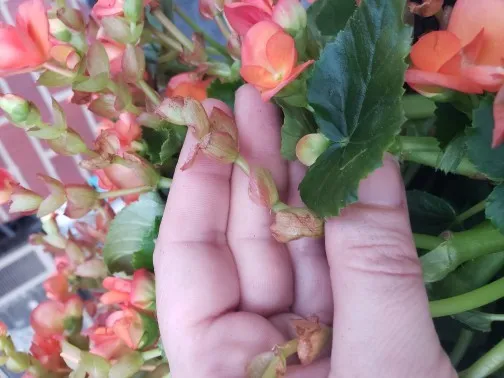
You may do all this, feed them water them etc., and still your begonias stop flowering. And the reason is that they have gone to seed. To avoid this, keep checking your plants and deadhead spent blooms regularly (I suggest daily).
It’s very easy; when flower petals begin to fade, you just need to snip off the spent flowers along with a bit of the stem with your fingers – the petioles are very tender indeed.
So Much for So Little! Begonias Are Really Generous Flowers!
And that’s all you need to do to keep your begonias blossoming for months on end! It’s not much at all, and they will regale you with a massive floral display all through the season. That’s maybe why they are favorites in flower beds in public parks – they are low maintenance and very generous indeed!

Written By
Amber Noyes
Amber Noyes was born and raised in a suburban California town, San Mateo. She holds a master’s degree in horticulture from the University of California as well as a BS in Biology from the University of San Francisco. With experience working on an organic farm, water conservation research, farmers’ markets, and plant nursery, she understands what makes plants thrive and how we can better understand the connection between microclimate and plant health. When she’s not on the land, Amber loves informing people of new ideas/things related to gardening, especially organic gardening, houseplants, and growing plants in a small space.